
Loading...
Cart is empty
Browse the shop to add prints
Use these sections to discover artworks, read technical context, and navigate the full algorithmic art ecosystem.
A test article showcasing all three interactive visualization block types: Mandelbrot WebGL viewer, Math Orbit 2D plotter, and Color Cube placeholder.
Technical deep-dive into implementing a performant Mandelbrot/Julia set explorer with WebGL and progressive rendering.
From image processing utility to creative medium — how applying matrices to noise fields unlocked a new visual language.
From low-resolution cameras to algorithmic abstraction — the four-stage pipeline behind every BVDART artwork.
Every artwork begins with raw material. Source imagery is never the final product — it's the seed from which algorithmic evolution grows.
Algorithms are designed, combined, and parameterised to create reusable effect sequences. Each algorithm is a building block; the engineering is in how they chain together.
Available Building Blocks
Example Effect Chains:
Two fundamentally different approaches produce different kinds of work. Both use the same algorithmic tools, but the relationship between artist and algorithm is inverted.
Deliberate, parameter-driven composition. The artist defines the algorithm, controls every variable, and iterates toward a predetermined vision. The output is predictable and reproducible.
Define convolution matrices — edge detection, blur, sharpen, emboss. Each kernel encodes a visual operation as pure mathematics.
Generate Perlin, Worley, or value noise at multiple octaves. Layered noise creates organic complexity from simple functions.
Shift between RGB, HSL, OKLCH, and indexed palettes. Mathematical color manipulation enables effects impossible in traditional media.
The final stage bridges digital and physical. Multiple production methods serve different purposes — from accessible reproductions to limited collector editions with provenance guarantees.
Printers optimised for accurate pixel art reproduction — each source pixel maps to a precise dot group with no interpolation. Modified firmware disables the printer's built-in smoothing and dithering.
Legacy printers as creative tools. The mechanical imprecision of dot matrix heads and the ink bleeding of early bubble jets add a physical layer of abstraction — the printer collaborates with the algorithm.
Affordable reproductions through established print-on-demand platforms. Accessible entry point — customers choose size, material, and framing.
Low resolution is not a limitation — it's a compositional tool. 640×480 forces clarity. JPEG artifacts become texture. Dot matrix imprecision becomes collaboration. Every constraint narrows the search space and amplifies creative signal.
The code is not a tool — it's a co-author. The artist defines rules; the algorithm explores the space those rules create. The best pieces emerge from the tension between control and emergence — where the output surprises even its creator.
The print is not a reproduction — it's a translation. Each production method interprets the digital master differently. The modified printer preserves intent; the dot matrix reinterprets it. Both are valid. The medium is part of the message.
Vintage cameras like the Sony Mavica MVC-FD91 — floppy-disk photography at 640×480. The inherent compression artifacts and limited dynamic range become features, not flaws. Each JPEG artifact is a collaboration between silicon and intention.
Resolution constraints force compositional discipline. What survives lossy compression reveals the essential.
Procedural imagery from code — Perlin noise fields, fractal landscapes, cellular automata, reaction-diffusion systems. Every pixel is computed, never captured.
Algorithms as collaborators. The code proposes, the artist curates.
Hand-drawn marks digitised and fed into the pipeline. Human gesture meets computational transformation — the imprecision of the hand becomes raw material for algorithmic processing.
The human mark provides what algorithms cannot: intentional imperfection.
Planets, vintage clipart, scientific imagery, botanical illustrations — anything that sparks inspiration. These seed images are never the output; they're the starting condition for algorithmic evolution.
Found imagery as cultural DNA. The algorithm transforms context into abstraction.
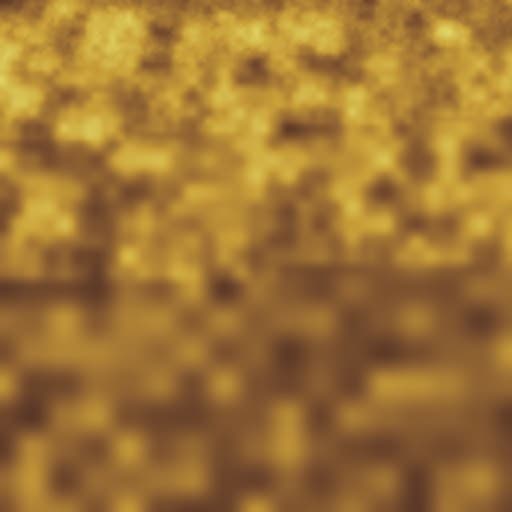
Example source texture · Organic pattern
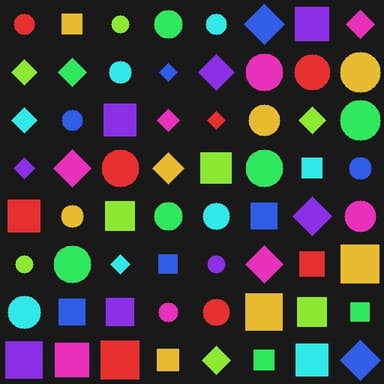
Example output · Pattern generator
Each chain produces a distinct aesthetic. Chains are saved, versioned, and reused across artworks — creating a personal library of visual transformations. Explore these algorithms interactively in the Lab.
Run algorithms repeatedly with parameter sweeps. Each iteration compounds transformations, building visual depth.
Layer and blend multiple passes using mathematical operations — multiply, screen, difference, dissolve.
Starting with a source canvas and applying a long series of tools, algorithms, and effects — guided not by knowledge of the effect but by the visual output. The artist doesn't think about what the key does; the abstraction emerges from pure intuition and response.
◐The Cashier Panel — 128 Keys
Each key is bound to an effect macro. No labels — the artist works by feel, not by name. The panel removes the possibility of deliberation.
An unmarked keyboard with 128 keys mapped to effect macros. No labels — muscle memory replaces deliberation.
Apply algorithms sequentially to a live canvas. Each key press transforms the entire image in real time.
Decisions guided entirely by visual output, not by knowing which effect was applied. The abstraction emerges from intuition, not planning.
Unexpected combinations produce results no deliberate process would reach. The panel encourages exploration over control.
| Aspect | Mathematical (A) | Intuitive (B) |
|---|---|---|
| Intent | Predetermined vision | Emergent discovery |
| Control | Full parameter control | Output-guided intuition |
| Interface | IDE / parameter UI | 128-key unmarked panel |
| Reproducible | Yes — deterministic | No — unique per session |
| Aesthetic | Precise, structured | Abstract, organic |
Numbered, limited-run prints on archival paper with certificate of authenticity. Manually ordered and quality-checked. Each edition can be paired with a Polygon NFT for provenance verification and optional reproduction stop.
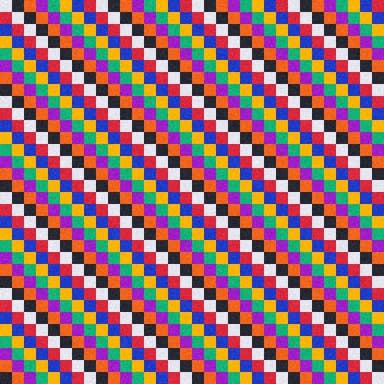
Digital master · Pixel-accurate
Production Paths:
Signed & numbered limited-edition prints — each a unique collector’s piece with certificate of authenticity, archival fine-art paper, and optional blockchain provenance.

Pixel-noise fields form diagonal bands in yellow, blue, coral, and purple.

Soft pixel blocks blend into a chromatic haze.

Dense pixel grid forms a soft monochrome gradient field.

Cyan, green, and magenta fields ripple across a dense pixel grid.


